Travel Plug Adapters and Voltage: What You Need for Each Country
Outlets and voltage differ around the world, so a US plug often won't fit, and some devices can be damaged. This guide shows the plug types and voltage in popular destinations, explains adapters vs voltage converters, how to check your devices, what to buy and how to stay safe.
By Pond.com editors Updated 4 min read

Quick answer
- The US uses plug types A and B at 120 volts; most of the world uses 220 to 240 volts and different plug shapes.
- A plug adapter only changes the shape of the plug; it doesn't change the voltage.
- Phone, tablet, laptop and camera chargers are almost always dual voltage (100–240V), so they only need an adapter.
- Hair dryers, flat irons and other heating appliances are often 120V only and can be damaged abroad without a converter or a dual-voltage model.
- A universal adapter with USB-C ports covers most countries and charges several devices at once.
Arriving at a hotel with a dead phone and a plug that doesn't fit is an easy problem to avoid. Most travelers only need a small plug adapter, but a few devices can be damaged by the higher voltage used in most of the world.
This guide is general information. Always check the label on each device before plugging it in abroad.
Plug types and voltage in popular destinations
The US uses type A (two flat pins) and type B (two flat pins and a round ground pin) at 120 volts.
| Destination | Plug types | Voltage |
|---|---|---|
| Canada | A, B | 120V |
| Mexico | A, B | 127V |
| Caribbean (most islands), Costa Rica | A, B | 110–120V |
| UK, Ireland | G | 230V |
| France, Germany, Spain, Netherlands, Portugal, Greece | C, F (France also E) | 230V |
| Italy | C, F, L | 230V |
| Switzerland | C, J | 230V |
| Iceland, Turkey | C, F | 230V |
| Japan | A, B | 100V |
| South Korea | C, F | 220V |
| China | A, C, I | 220V |
| India | C, D, M | 230V |
| Thailand | A, B, C, O | 230V |
| Philippines | A, B, C | 220V |
| Australia, New Zealand | I | 230V |
| United Arab Emirates | G | 230V |
| Israel | C, H | 230V |
| South Africa | C, D, M, N | 230V |
| Brazil | C, N | 127V or 220V, depending on the area |
Some countries, like Thailand and the Philippines, have outlets that a US plug fits, but at 220 to 230 volts. A plug fitting doesn't mean the voltage is safe for your device.
Adapter or converter?
- A plug adapter changes only the shape of the plug so it fits the outlet. The power coming out is still the local voltage.
- A voltage converter (or transformer) steps the local voltage down to 120V for devices that can't handle more.
Check your devices
Look on the charger or the device's label for its input rating:
- "Input: 100–240V" means it's dual voltage. It works anywhere and only needs a plug adapter. Almost all phone, tablet, laptop, camera and e-reader chargers are like this.
- "Input: 120V" or "110–125V" means it's US only. On 230V it can overheat or burn out within seconds.
Devices most likely to be US-only are those that heat up or have motors: hair dryers, flat irons, curling irons, electric shavers, kettles and some CPAP machines. Many hair tools have a small dual-voltage switch, so check before you go. See using a hair dryer or straightener abroad.
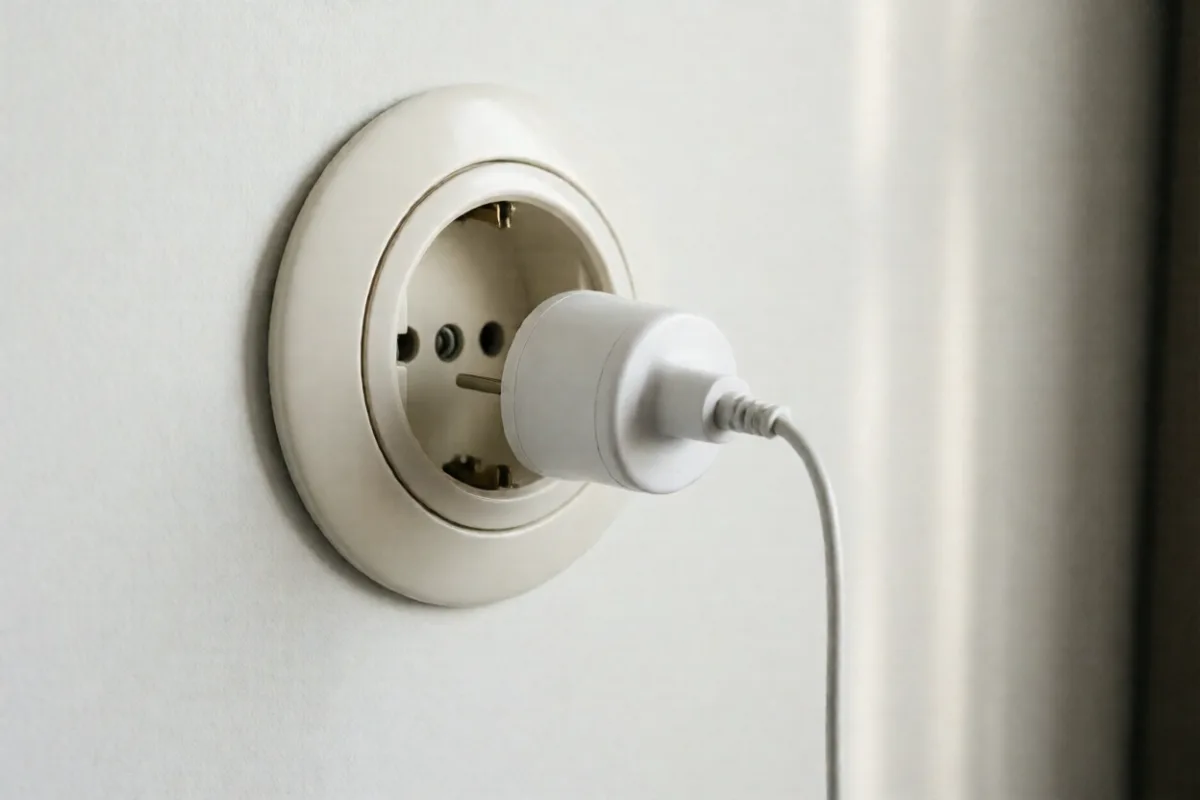
What to buy
- For most trips: a compact universal adapter with USB-C and USB-A ports. It covers types A, C, G and I in one unit and lets you charge several devices from one outlet.
- For one country: single adapters are small and cheap. Buy two if you have lots of devices.
- For heating appliances: buy a dual-voltage hair tool rather than a converter. Converters for high-wattage devices are heavy, and cheaper ones often fail. Most hotels also provide a hair dryer.
- For medical devices: check with the manufacturer. Many CPAP machines have dual-voltage power supplies. See traveling with a CPAP machine.
Staying safe
- Never plug a US-only device into a 230V outlet through an adapter alone.
- Check grounding. Many travel adapters don't pass through the ground pin, which is fine for phone chargers but not ideal for laptops with three-prong plugs on long trips.
- Don't overload adapters with power strips or several high-wattage devices.
- Unplug adapters that get hot, smell of burning or fit loosely in the socket.
- Watch the frequency: most countries outside the Americas use 50 hertz instead of 60. It doesn't affect chargers, but clocks and some motors can run at the wrong speed.
Common questions
Most of continental Europe uses type C and F sockets, so a type C adapter (two round pins) fits almost everywhere, including France, Germany, Spain, Italy, the Netherlands and Greece. The UK and Ireland use type G, which needs a different adapter.
No. Canada and Mexico use the same type A and B outlets as the US, at similar voltage, so your plugs and devices work as they do at home. Some older buildings in Mexico have only two-slot outlets, so a three-prong plug may need a simple adapter.
Only with dual-voltage devices, and only if the power strip itself is rated for 250 volts. Many US power strips and surge protectors are made for 120 volts and can overheat or fail on 230 volts. A travel power strip rated for both is safer.
Many hotel USB ports are slow, and some can't charge a laptop at all. A small adapter and your own fast charger are more reliable, and they let you charge from any wall outlet.