How to Plan a Road Trip
A great road trip balances driving time with time to enjoy the places you stop. Here's how to plan a realistic route, budget for gas and lodging, get your car ready, pack the right emergency kit and stay safe on the road.
By Pond.com editors Updated 5 min read

Quick answer
- Keep driving days to about 6 to 8 hours at most, and plan a break every 2 hours or so.
- Budget for fuel by dividing the total miles by your car's miles per gallon and multiplying by the price per gallon.
- Get your car checked before you go, including tires, oil, fluids, brakes, wipers and the battery.
- Book lodging and campsites ahead in popular areas, and check whether national parks need timed-entry reservations.
- Download offline maps, since cell service disappears in many rural and mountain areas.
A road trip gives you freedom that flying can't: you set the pace, stop where you like and carry as much as fits in the car. The best road trips balance time behind the wheel with time to enjoy the places along the way. A bit of planning makes the difference between a memorable trip and a long, tiring drive.
Step 1: Pick a route and a pace
- Choose a theme or a loop. National parks, a coastline, small towns or a string of cities give the trip a shape. A loop avoids one-way rental fees and backtracking.
- Keep driving days reasonable. About 6 to 8 hours of driving is a comfortable maximum for most people, and less is better. Map apps assume no stops, so add about 25% for fuel, food and breaks.
- Plan breaks every 2 hours or so.
- Build in rest days. Staying two nights in some places lets you explore without packing up every morning.
- Check road and weather conditions for mountain passes and seasonal roads, some of which close for months in winter.
Step 2: Budget for the trip
| Cost | How to estimate |
|---|---|
| Fuel | Total miles ÷ your car's mpg × price per gallon |
| Lodging | Number of nights × typical rate for the area; campsites cost less |
| Food | Groceries and a cooler cut costs; budget for some meals out |
| Park and attraction fees | An annual national parks pass often pays for itself after 2 or 3 parks |
| Tolls and parking | Check your route; some toll roads are cashless and bill by plate or transponder |
| Car prep and wear | An oil change and inspection before you go |
Example: a 1,500-mile trip in a car that gets 30 miles per gallon uses about 50 gallons of fuel. At $3.50 a gallon, that's about $175. Add 10 to 15% for detours and city driving.
Electric car? Plan charging stops with your car's app or a charging map, and check for fast chargers along rural stretches, where they can be far apart.
What will your road trip cost in gas? Enter the distance and your car's mpg, and split the cost. Open calculatorStep 3: Get your car ready
A breakdown far from home can ruin a trip. A week or two before you leave, check or have a mechanic check:
- Tires, including the spare: tread depth, any damage, and pressure (use the number on the sticker inside the driver's door, not on the tire).
- Oil and other fluids: coolant, brake fluid, transmission fluid and washer fluid.
- Brakes, especially if they squeal or feel soft.
- Wipers and lights.
- Battery, especially if it's more than three or four years old.
- Air conditioning before a summer desert or southern trip.
If your car is overdue for service, get it done before the trip rather than on the road.
Check your car insurance and roadside help
- Know what your policy covers. Check your deductibles and whether you have roadside assistance or rental reimbursement if your car breaks down far from home. Roadside help is often a cheap add-on to a car insurance policy, and auto clubs and some credit cards offer it too.
- Driving to Canada? U.S. car insurance policies generally cover you there, but carry your insurance card and ask your insurer whether you need a Canadian proof-of-insurance card.
- Driving to Mexico? Most U.S. policies don't cover you in Mexico, and Mexican law requires liability insurance from a Mexican-authorized insurer. Buy a Mexican policy before you cross the border.
- Keep proof of insurance in the car, on paper or in your insurer's app.
Step 4: Book what sells out
- Lodging in popular areas, especially near national parks, beaches and big events, and on summer and holiday weekends.
- Campsites in national and state parks, which often open months in advance.
- Park reservations. Some popular national parks require timed-entry or vehicle reservations at busy times. Rules change by season, so check each park's page on nps.gov.
- A national parks pass. The America the Beautiful annual pass costs $80 for U.S. residents and covers the entrance fees at national parks and other federal recreation sites for a year.
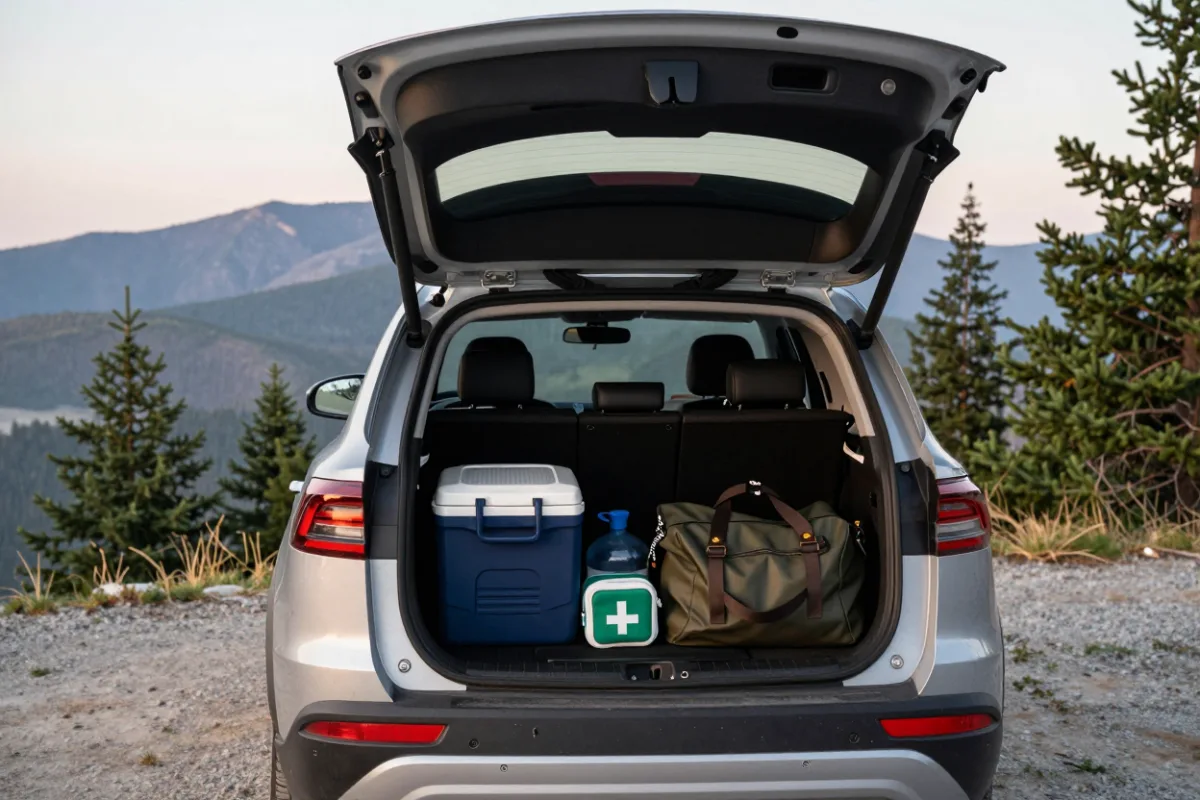
Step 5: Pack the car
Car emergency kit
- Jumper cables or a portable jump starter
- Tire pressure gauge and a portable air compressor
- First-aid kit
- Flashlight with spare batteries
- Reflective warning triangles
- Basic tools, duct tape and a utility knife
- Phone charging cable and a power bank
- Extra water and nonperishable snacks
- Blanket, and in winter, an ice scraper, small shovel and warm clothing
For comfort
- A cooler for drinks and lunches
- Trash bags and wipes
- Pillows and blankets for passengers
- Downloaded music, podcasts and audiobooks
- Sunglasses and sunscreen
Documents
- Driver's license, vehicle registration and proof of insurance
- Roadside assistance details, if you have it
- Reservations and park passes
Step 6: Stay safe on the road
- Don't drive drowsy. Pull over and rest or swap drivers if you feel tired. Avoid long drives late at night.
- Download offline maps. Cell service disappears in many rural and mountain areas.
- Fill up early. In remote areas, gas stations can be 100 miles or more apart. Refill when you reach half a tank.
- Share your route with someone at home, especially in remote areas.
- Watch for wildlife at dawn and dusk, when deer and other animals are most active.
- Never leave children or pets in a parked car. Temperatures inside can become deadly within minutes, even on mild days.
Common questions
About 6 to 8 hours is a comfortable maximum for most people, with breaks every couple of hours. Shorter days leave time to enjoy stops along the way. If you're driving alone, aim for less.
Divide your total miles by your car's average miles per gallon, then multiply by the average gas price. For example, 1,500 miles in a car that gets 30 mpg uses about 50 gallons; at $3.50 a gallon, that's about $175. Add 10 to 15% for detours and city driving.
A rental can make sense if your car is old, unreliable or uses a lot of fuel, or if you want to avoid adding miles. Check mileage limits and one-way drop-off fees before you book, and find out whether your own car insurance and the credit card you pay with cover a rental car, so you know whether to buy the rental company's coverage.
Some popular parks require timed-entry or vehicle reservations at busy times of year, and these rules change from season to season. Check each park's page on nps.gov before you go. Lodging and campgrounds in and near popular parks often book up months ahead.
The America the Beautiful annual pass costs $80 for U.S. residents and covers entrance fees at national parks and other federal recreation sites for a year. Non-residents pay more, and some parks charge non-residents an extra fee.