Pond Lights: How to Light Your Pond Safely
The right lighting makes a pond as enjoyable at night as it is by day. Here's how to choose between low-voltage, solar and floating pond lights, where to place them for the best effect and how to install them safely.
By Pond.com editors Updated 4 min read

Quick answer
- Low-voltage (12-volt) LED lights are the safest and most popular choice for lighting a pond.
- Only put lights in the water if they're rated for underwater use (look for IP68).
- Plug the transformer into a GFCI-protected outdoor outlet, at least 6 ft from the water.
- Light the features, such as waterfalls, plants and stones, and hide the light itself.
- Use a timer or dusk sensor and switch lights off later at night, so fish and wildlife get some darkness.
A pond doesn't have to disappear when the sun goes down. A few well-placed lights can make a waterfall glow, pick out the shapes of plants and stones, and show off your fish on a summer evening. Done well, lighting makes the pond feel like an extra room in the garden.
This guide covers the types of pond light, where to place them for the best effect and how to install them safely.
Types of pond lights
| Type | Power | Good for | Watch out for |
|---|---|---|---|
| Low-voltage LED | 12 volts, through a plug-in transformer | Most ponds: underwater, waterfall and edge lighting | Needs a GFCI outlet for the transformer |
| Solar | Built-in solar panel | Accent lights, floating lights, no wiring | Dimmer; depends on daytime sun |
| Floating | Usually solar or battery | Decorative effects on the surface | Mainly ornamental |
| Line-voltage | 120 volts, hardwired | Bright floodlighting of large areas | Must be installed by a licensed electrician |
For almost every backyard pond, low-voltage LED lighting is the best choice. The transformer plugs into a standard outdoor outlet and steps the power down to 12 volts. That's far safer near water, and you can install the lights yourself. LEDs also use very little power and last for years.
Where to put the lights
The best pond lighting shows off the features, not the light fixtures. A few principles:
- Light the waterfall. A light set just under the water at the bottom of a waterfall, pointing up into the falling water, makes the whole feature glow.
- Light a fountain from below. A small light under the spray makes the water sparkle.
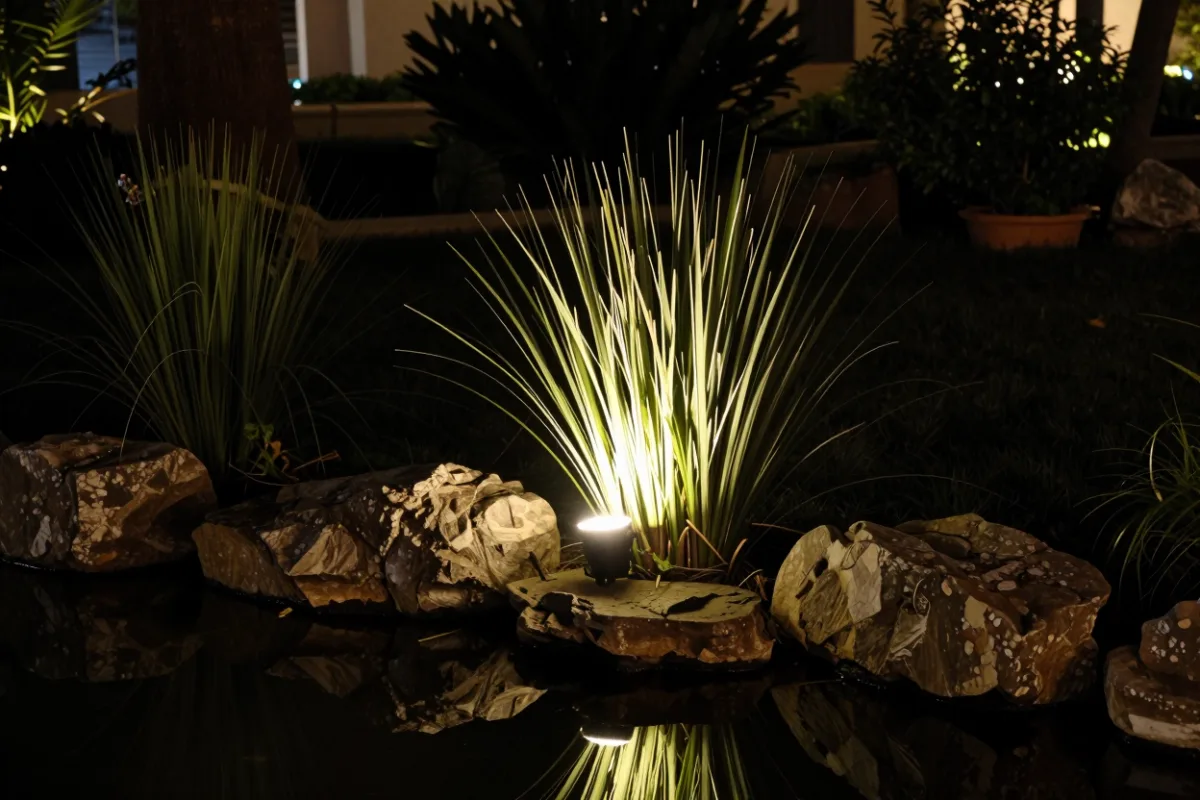
- Uplight plants and stones. A spotlight hidden among the stones at the edge, aimed at a tall grass or a feature rock, creates shadows and reflections.
- Point lights away from where people sit. Aim them toward the feature and away from the patio and windows, so no one is dazzled.
- Hide the fixture. Tuck lights behind rocks or plants so you see the glow, not the lamp.
- Use fewer lights. Two or three carefully placed lights usually look better than a ring of lights around the edge.
Choosing a color
Warm white suits most gardens and looks natural on water, stone and plants. Colored and color-changing lights can be fun for parties and fountains, but a little goes a long way. Many LED sets let you switch between white and colors.
How to install low-voltage pond lights
- Plan the layout. Decide which features you want to light, and where the transformer will go near your outlet.
- Check the transformer size. Add up the wattage of all the lights, and choose a transformer rated comfortably above that total.
- Place the lights. Set underwater lights on the bottom or on a shelf, weighted with stones, and aim them at the feature. Set edge lights on their stakes among plants and rocks.
- Run the cable. Hide it under edging stones, or bury it in a shallow trench away from where you'll dig or mow. Call 811 before digging any trench.
- Connect to the transformer and plug it into the GFCI-protected outlet.
- Test after dark. Adjust the angle of each light until it looks right, and move any that shine into your eyes from the patio.
Light and wildlife
Fish, frogs and other pond wildlife are used to dark nights. Lights left on all night can disturb them and attract insects.
- Switch off later in the evening. A timer that turns the lights off a few hours after dark is a good compromise.
- Use softer light. Bright floodlights aren't needed. Low, warm light is kinder to wildlife and more relaxing.
- Leave a dark corner. Keep part of the pond unlit, so fish and frogs have somewhere to retreat.
Care and maintenance
- Wipe the lenses of underwater lights every few months. Algae and scale build up and dim the light.
- Check cables each spring for damage from tools, animals or frost.
- Lift out underwater lights in freezing climates if the maker recommends it, and store them for winter.
- Unplug the transformer before moving or cleaning any light.
Common questions
Yes, when they're rated for underwater use and installed properly. Low-voltage LED lights stay cool and don't heat the water. Switching them off for part of the night gives fish a natural rest period.
Low-voltage lights run at 12 volts through a transformer that plugs into a standard outlet, so they're much safer around water and easy to install yourself. Line-voltage (120-volt) lights are brighter but need hardwiring by a licensed electrician.
They're easy to install and need no wiring, but they're dimmer than wired lights and depend on how much sun the panel gets during the day. They're best for gentle accent lighting and floating decorative lights.
Fewer than you'd think. Two or three well-placed lights on a waterfall, fountain or feature plant usually look better than a ring of lights around the edge.
It's better not to. Use a timer to switch them off a few hours after dark. Fish, frogs and other wildlife are used to darkness at night, and you'll save power too.
Step 12 of 15 in the complete pond guide Next: Pond Maintenance Through the Year: A Season-by-Season Guide