
How to Choose the Correct Pond Pump and Maintainance
Features such as waterfalls, streams and fountains add a whole new dimension to a garden or fish pond. All of these features require a pond pump to function correctly. There are numerous types of pumps available on the market. Selecting the right pump involves far more than finding a brand name or a good deal on the price. There will be some math involved in this process and one must also ensure that their safety is properly considered. After all, installing a pump means installing an electrical device in water which can be very dangerous if done incorrectly.
Safety
Before even getting started, one must make certain that they have the correct hardware for the job where safety is concerned. The garden pond pump should only be powered by an outdoor outlet unless it is a solar pond pump, in which case it will be solar powered. This outlet absolutely must have a Ground Fault Interrupter (GFI) installed on it. The GFI is a device which most people have seen on their bathroom outlets. These devices serve to break the circuit when water comes into contact with any electrical device. Without such a device, safety cannot be guaranteed.
One must also make certain that their outdoor outlet is a proper distance from the pond. A minimum distance of 6 feet is desirable though a distance of 10 feet is better still. This ensures that the outlet does not come into contact with the water when one is working on the pumps or filters. Given the proper safety equipment, it's time to proceed with selecting the garden pond pump!
Water Quantity
Pond pumps are rated according to how much water they can move over a given time. In the case of smaller pumps, they will carry a rating listed as GPH which stands for Gallons per Hour. This rating refers to the amount of water that the pump can move in one hour and refers to a specified height. The height above the ponds surface that the water must be carried to is known as the "head". The maximum flow rate will be achieved when there is zero head, as the head height increases the flow rate will diminish. Waterfall pumps are normally advertised with flow charts that display the GPH at incrementing head heights. Therefore, if one's pump will be carrying the water to an elevation, check the pumps flow chart to ensure it will provide adequate flow at the necessary head height.
Solar pumps are not very powerful and generally solar is only used to power a pond fountain pump. Very powerful pumps are rated in horsepower. These ratings - and occasionally GPH ratings, as well - are sometimes referenced to a chart provided by the manufacturer. These charts make it easier to determine how much water the pump will actually move in any given situation. Some stores will have this information listed generically, as well, which can help one to select a pump with enough power for the job.
Above and Below
Some pumps are stationed above the water and some submerged. Each has its own particular advantages and disadvantages.
The above water type are very easy to maintain and troubleshoot. They're also kept clean of many of the pollutants such as sand and gravel that may have a negative impact on the performance of submersible type. These pumps, however, can be very pricey and the more powerful units may generate a lot of noise. This noise, of course, can detract from the effect of the water features they power and make the entire environment much less attractive.
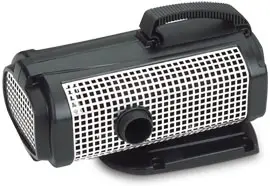
Submersible pumps are more popular for small ponds than their surface-mounted cousins. These are placed directly into the water where they operate almost silently. Of course, if there are problems with these pumps one must go through the hassle of pulling it out of the water to repair it and there is the hazard that the pump may gradually break down without it being apparent to the owner until it's too late.
Submersible pond pumps are also susceptible to contaminants floating in the water. There are pumps available that operate via magnetic engines. These are preferable to the older pumps. The older type required oil and coolant to operate properly. If they happened to have a failure which resulted in a rupture, this pollutant could easily end up in the water. Oils can interfere with oxygen exchange and present a poison hazard in and of themselves to anything living in the water. The magnetic pond pumps do not suffer from this drawback and, therefore, have become very popular with owners. Magnetic drives are very simple and, because of that simplicity of design, there is very little to go wrong in these devices.
Some pond owners attempt to use swimming pool pumps in their ponds. This is generally not recommended. A swimming pool is a much cleaner environment than a pond and those are not designed to deal with the particulate pollution. Purpose-built pumps are the best choice.
Doing the Math
The amount of work done by the pond pump depends both on the height (static head) and the distance the water must be carried through the hose (friction head). To approximate the friction head, for every 10 feet of hose the water must be moved is equivalent to carrying the water 1 foot high. The static head is determined by measuring from the surface of the pond to the top of the waterfall or pond fountain. For example, if one's waterfall is three feet above the pond surface and the water is carried through 20 feet of hose, the total head will be equivalent to five feet.
Where the size of the pond waterfall or stream is concerned, every inch of width is the equivalent of 150 gallons over the course of an hour. A waterfall with a 5 inch spillway, for instance, will require a pump that produces 750 gallons per hour in raw flow.
The pump should circulate half the water at least once per hour or for a koi pond the entire volume should be circulated at least once per hour, the pond pump calculator can work out the required flow rate. To determine the volume use the pond volume calculator. Or to do it manually, the formula is (length * width * depth). If the pond is circular or odd-shaped, break it down into small rectangles to figure out the volume. For every square foot of volume there are 7.5 gallons of water. A pond that has a volume of 100 cubic feet will contain roughly 750 gallons of water. Most ponds, of course, are much smaller than this. From this figure, one can determine the GPH rating needed for proper circulation of the water.