
A fish pond is one of the most delightful additions that anyone can make to their garden. When creating such a feature, keep in mind that one is actually creating a small ecosystem. The fish will need adequate room in which to move, will need a place to hide below the freeze line when winter comes and, depending on which type of pond fish one selects, one will have to adapt their selection of plants to accommodate their finned friends.
Any endeavor of this complexity starts with planning. The first thing one must plan is, of course, its location. Ideally, it should be visible from the house. If it is located in a particularly extensive garden, one may choose to locate it with regard given to its being visible from any part of the garden rather than toward being visible from the house. Keep in mind that, depending on what type of plants one plans, shade will be a huge factor. The water temperature will be much lower if the fish pond is located in perpetual shade. This will affect both the fish and the plants.
Though it may sound counterintuitive, one does not want water running into their fish pond. The reason for this is that water that runs across the ground is likely contaminated with fertilizers, garbage and chemicals. While the fish pond is necessarily exposed to the environment, one should endeavor to control that exposure as much as possible. A build up of fertilizers, aside from being potentially toxic to any fish, will also encourage the growth of algae and other undesired organisms. Garbage and other debris present an obvious hazard.
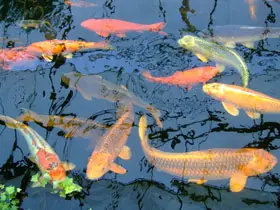
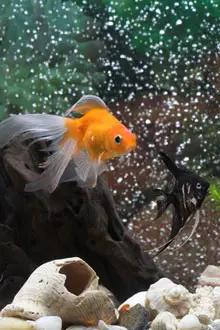
The type of pond fish selected will have a great influence on one's ability to successfully populate the pond with plants. While goldfish are harmless to just about any plant, koi fish will make a meal of certain types of pond plants. If one is interested in featuring plants as much as fish, koi fish may not be the best choice, goldfish would be ideal however. Koi do make fantastic garden fish ponds all on their own, of course, and this is usually one of the first decisions that one must make.
The shape will be the next decision and this is where the actual building starts. One can use a chalk line, a hose or a rope to outline the edges of the pond. The shape should take into consideration one's aesthetic concerns and, of course, the amount of space one can afford to dedicate. When outlining the pond, remember that there will need to be adequate space to accommodate several levels of depth as many water plants will need to be planted at a shallower level and fish, of course, will want more space to move around.
Where goldfish are concerned, a goldfish pond only needs to be about 2 feet deep. However, one must make accommodations for winter when the water will freeze. The colder one's region, the more depth will be required to ensure that the water does not freeze completely in the winter. In zone 5 or colder, a pond should be at least 3 feet deep to avoid the fish being frozen out.
Koi are larger fish and, thus, need more room. Fish ponds designed to accommodate koi fish should always be at least 3 feet deep, no matter in what zone it happens to be located. Koi like room to move around so it's generally better to make it deeper than this, if possible. There are other reasons to make it deeper besides accommodating the fish.
Larger fish ponds obviously have more water and, though it may seem somewhat backwards, are easier to maintain than a smaller one. The water level will be more stable and the pond will be less likely to fill up with nuisance plants such as algae. Of course, when debris inevitably does make its way in, it will have far less impact than it would in a smaller pond where there is less water to pollute.
Dig the pond with several levels. If water plants are among one's plans, put a "shelf" about a foot below the water line so that the plants have a place on which to grow. Another shelf should be located at just below the surface around the perimeter of the pond. The deepest point should be in the middle of the largest pool, if there are two, or directly in the center if one is creating a simple circular shape. For fish ponds which are long and narrow, most builders prefer to make a three level floor consisting of a shallow section of about a foot in depth, a middle section of about two feet in depth and a third section that contains the deepest water.
Some type of filtration device will be required. There are numerous types of pond filters available on the market, some of them are set below the water line and others are of the "skimmer" variety which take water from the surface. Most often, skimmers are used to feed a waterfall or an artificial stream that leads away from the pond. The more water circulates, the cleaner it will remain and the less hospitable it will be to insects and other nuisances.
Fish ponds will need to be kept clean. Some of this will be accomplished by the addition of various chemicals, such as dechlorinators and some of it accomplished via natural means. The various pond supplies can be purchased in kit form containing everything one needs or individually. Adding aquatic plants, for example, helps keep the water fresh. These plants consume the nutrients required by algae and help keep the water free of this nasty, odorous type of growth. Debris including leaves, windblown trash and other items will need to be taken out of the water. This can be done with a net or other straining device.